



Here’s some background on Tsinghua University’s new phase of collaboration with Meituan
Drones deliver food, and driverless vehicles deliver everyday goods. It is hard to talk about the delivery and logistics revolution in Chinese society without mentioning AI, given how central it has become to Meituan’s growth story.
These days, AI news tends to follow a set pattern: “this model got smarter,” “it draws better,” “it writes code faster” — things that mostly happen on a screen. But amid all that, a different kind of story caught our eye. On July 15, Tsinghua University and Meituan announced the second phase of their “Digital Intelligence Living Joint Research Center” collaboration.
The goal of this round of collaboration is for AI to actually see the real world, make judgments, and move a physical body — a robot — to get things done. In the industry this is called “physical AI, embodied intelligence, applied intelligence.”
So — what exactly does Meituan do as a company? It’s often nicknamed “China’s DoorDash,” but that undersells it; delivery is really just the starting point.
Founded in 2010, the company’s reach extends far beyond food delivery — hotel and travel bookings, ticket purchases, online shopping, bike- and car-sharing, even medical and language-learning services. It touches nearly every corner of daily life. As of the end of last year (December 2025), it was reportedly even selling the weight-management drug ‘Mounjaro’ on its platform. It’s easy to see why the company earned the nickname “Baemin” locally — a mash-up of a night owl, a courier, and a Gangnam socialite, all rolled into one.
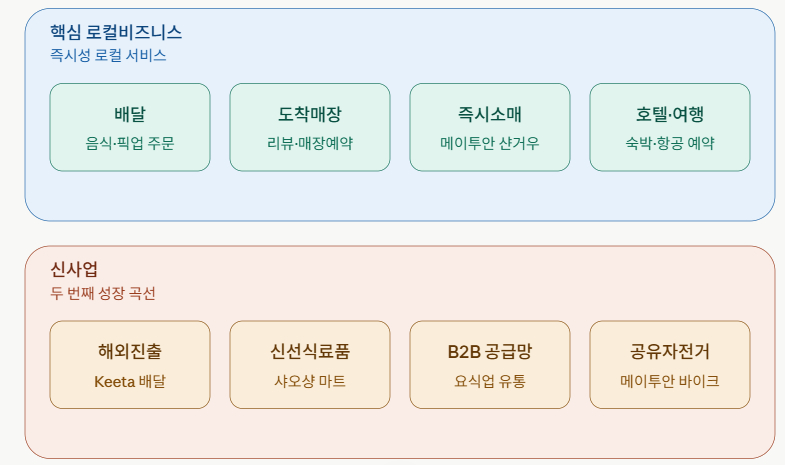
Meituan’s core businesses, phase 1 & 2
The founder behind the company is Wang Xing — and his backstory is a fun one. He’s a serial entrepreneur who has started five companies. After studying electrical engineering at Tsinghua and graduating in 2001, he went to the US for graduate study at the University of Delaware. But what caught his attention there wasn’t his coursework — it was the social-media wave sweeping the US at the time. He eventually returned to China and built his early ventures around that same model, earning himself the nickname “China’s Mark Zuckerberg.”
A Tsinghua graduate who drew inspiration from Facebook, and who is now — fittingly, like a circle closing — teaming up with his alma mater to run an AI research center with his fifth company. But this isn’t actually their first joint effort: the two have been running this program for five years already, since 2021, and the five-year track record speaks for itself.
- AI-driven route optimization for delivery → already deployed in the real-time delivery systems serving city residents right now
- Acoustic positioning technology that keeps drones from losing their way over crowded downtown rooftops → won 2nd place for best paper at the ACM SenSys conference
- Perception and obstacle-avoidance technology for driverless delivery vehicles navigating city streets → won 1st prize for technical invention from the China Society of Automotive Engineers
So this isn’t a case of “one industry-academia white paper and we’re done” — it’s a team that has quietly been doing this work every time we order from a delivery app. And winning awards for it.
Highlights
- For phase 2, Meituan is contributing its own trillion-parameter model, developed in-house and fully open-sourced: LongCat-2.0.
- They’re placing their bets on three fronts: the low-altitude economy (more drones, more safely), embodied intelligence (last-mile delivery robots), and decision intelligence (real-time delivery/recommendation optimization) — a signal of where the business is expanding next.
- Of the three, the one that stands out most is the last-mile robot. It makes sense — there’s no better proving ground for robots than delivery. Millions of real-world data points pile up every day, and conditions are far messier than any lab simulation: autonomous cars cutting in, elevators breaking down, dogs darting out of nowhere. From an AI standpoint, that mess is exactly the point — real-world training beats a clean simulation every time.

Meituan’s future-technology roadmap, phase 3
What makes this news interesting, ultimately, isn’t a headline like “we’re building robots” — it’s closer to “we’ve quietly been building robots for five years, and now we’re scaling up.” As the AI race moves through the stages of perceptual AI, embodied intelligence, and applied intelligence, it’s worth watching closely which business areas come next.
[Reference — this post is edited from Meituan’s own published article]
For inquiries related to AI industry/product meetings, institutional interpretation, conference interpretation, corporate training, and on-site coordination, please contact us.